
New cascade frog named after social worker Padmini Varkey
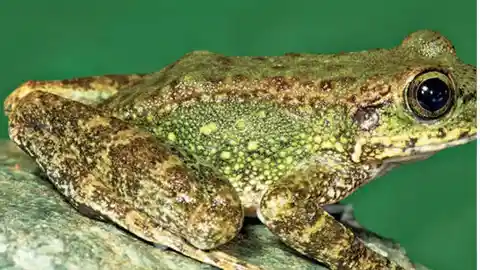
A newly discovered cascade frog species in Northeast India has been named "Ammachi Cascade" in honour of the late Malayali social worker Padmini Varkey.
Kollam (Kerala): One of the three newly discovered frog species from Northeast India has been named after a Malayali social worker. The frog species has been named using her affectionate moniker, "Ammachi", in memory of the late Malayali social worker Padmini Varkey.
The new frog species were discovered in Tripura, Nagaland and West Bengal. Living in forest streams and rocky waterfalls, they are known as "cascade frogs" or "forest stream frogs".
The name describes where the animals live rather than what they look like. Cascade frogs breed in and around fast-flowing hill streams and the spray zones of waterfalls, and that habitat is patchy by nature: two waterfalls a few kilometres apart can hold populations that have not exchanged genes for a very long time. It is a pattern that produces a great deal of local variation, which is why the group has yielded so many new species as survey work in the region has expanded.
The species named "Ammachi Cascade" in memory of Padmini Varkey was found in the Jampui Hills of Tripura. Measuring 80 mm in length, this frog has a light brown colour featuring olive-green patterns.
A measurement of that kind places it among the larger cascade frogs, and the colouring is functional rather than decorative. Frogs on rock faces beside a stream need to disappear against wet stone and leaf litter, and a mottled brown-and-olive pattern does that far better than any single colour would. Most species in the group are also active at night and at the water's edge, so a specimen in the hand is usually the result of a deliberate search rather than a chance sighting.
The "Sendenyu" frog is named after Sendenyu village in Nagaland, where it was discovered.
Naming a species after the place it was found is the most common convention in this kind of work, and it has a practical benefit: the name carries locality information that stays useful long after the paper is published. It also tends to be the choice when the people who found the animal want to acknowledge the community on whose land the work was done.
The "Beautiful Cascade" frog was found in West Bengal. Visually striking, it features a green body with yellowish-green or reddish-brown mosaic patterns. All three species belong to the 'Ranidae' frog family.
The study was published in the "Bulletin of the Museum of Comparative Zoology", an international scientific journal of Harvard University's Museum of Comparative Zoology.
Publishing in a journal of that standing matters because a species description is not accepted on the strength of a discovery alone. The name has to be proposed with a designated type specimen, a diagnosis distinguishing it from its closest relatives, and a comparison against material held in museum collections, which is why a description of this kind typically takes years between the first field collection and publication.
The team that made the discovery was led by Professor Dr S D Biju of Delhi University, popularly known as the "Frogman of India". The research team included K P Elle Paul, A N Dixit, Aklabya Sharma, K Radhakrishna Upadhyaya, Karan Bisht, Tage Tajo, James Hanken and Sonali Garg.
These three populations were confirmed as new species through lab studies that combined DNA analysis of adult frogs and tadpoles with detailed morphological comparisons.
Using both lines of evidence is now standard in amphibian taxonomy. Two populations can look nearly identical and still be genetically distinct, which is common in frogs because selection on body shape is often weaker than selection on colour, and coloration can vary within a single population. Matching the DNA of tadpoles to the adults they become is the step that confirms the two were assigned to the same species in the first place.
Who was Padmini Varkey?
Padmini Varkey rendered invaluable contributions to the field of palliative care, offering compassionate support to the intellectually challenged and isolated women. She dedicated her entire wealth to such social initiatives. Although a native of Kozhikode, her primary sphere of activity was Thiruvananthapuram. She was an official in the Department of Health. This naming marks her legacy on an international stage.
Naming a species after a person is one of the few permanent honours available in science, and taxonomists generally reserve it for someone whose work connects to the organism or the place. A species described in this way carries the name in every future paper, field guide and database record that mentions it, which is why the practice is treated as a considered decision by the describing authors rather than a courtesy.
Three new species described at once is also a reminder of how much of the region's amphibian fauna remains unrecorded. Northeast India sits at a meeting point of several biogeographic zones, and the hill streams there have been surveyed far less thoroughly than the Western Ghats, so descriptions of this kind usually prompt further work in the same catchments rather than closing the subject.
Padmini Varkey was the mother of Aruna, wife of Transport Minister C P John.
Camp Danger introduces kids to spiders, pocket dragons and Vlad the Impaler
Sargassum seaweed piles up on Marco Beach as turtle season hits 162 nests
A dog spots a 3ft python under the door in Honolulu, and eight police turn up
Piedmont library's critter day brings snakes, geckos and a tortoise

Man stops mid-ride to rescue a snake hiding in his bike
Humane Society International calls for an end to the wild turtle trade