
Meet the sulcata tortoises at the Monroe zoo
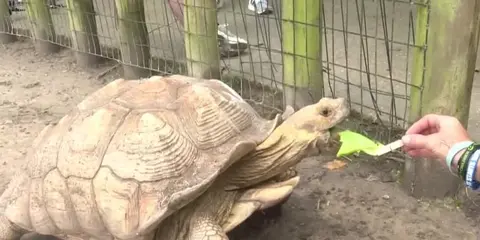
MONROE, La. (KNOE) - Come take a walk on the wild side! You can feed the Sulcata, or African-spurred, tortoises at the Louisiana Purchase Gardens and Zoo in Monroe.
Hands-on encounters of this kind are a staple of small and mid-sized zoos. Letting a visitor hold out a leaf and have an animal take it turns a passive look at an enclosure into something a child remembers, and it tends to be the part of a zoo visit that gets talked about afterwards. It also works best with herbivores that are comfortable around people, which is largely why tortoises end up in this role so often.
This species is from the desert-like regions of Africa. General Curator Lisa Taylor says they are the third-largest tortoise species in the world.
The comparison is worth dwelling on, because only the Galápagos and Aldabra tortoises are larger. A tortoise in that size class is not a scaled-up version of a box turtle: the shell has to support a body weight that keeps increasing for decades, and the legs are columnar rather than sprawling because they are carrying that load.
They are known as "spurred" tortoises because of the spurs on their arms and legs, which help them burrow.
"They're excellent diggers; they tend to create really deep tunnel systems to stay out of the heat, since they live in places where the sun beats down on them," explained zookeeper Al Hodges. "We have given them a lovely shaded area here."
Burrowing is how the species survives the environment it comes from. A tortoise underground is insulated from both the daytime heat and the cold of the night, and the humidity inside a burrow is far higher than at the surface, which matters for an animal that loses water slowly and cannot afford to lose much. It is also the reason a sulcata in a backyard will dig out under a fence: the behaviour is not escape so much as an animal doing what its instincts tell it to do with no burrow available.
They are common in the pet trade
Availability in the pet trade is largely a function of how easily the species breeds in captivity. Sulcatas produce large clutches reliably, which means hatchlings are inexpensive and easy to find at a size that fits in a hand — and that is precisely the problem, because the animal being sold at that size is the same animal that will eventually weigh as much as an adult person.
"They can live anywhere from 70 to 100 years; that's one of the things that has to be considered if you do try to get one as a pet," said Hodges.
A lifespan of that length outlasts the person buying the animal in many cases, and it is the detail most often missed at the point of sale. Reptile rescues and sanctuaries across the United States are full of sulcatas surrendered by owners who bought a hatchling and discovered a decade later that they were caring for an animal that needed a heated outbuilding, a reinforced enclosure and an arrangement for who would take it next.
These guys can get up to 150 pounds
"I call them living bulldozers because they like to push stuff around," said Taylor. "It will push out of fences and could do damage to your home."
The damage is not mischief. A tortoise does not understand that a wall is fixed; when something blocks its path it pushes, and at that weight a garden wall, a gate or a sliding door frame gives way. Zoos housing them build accordingly, with buried barriers rather than surface fencing, for the same reason.
You can feed the tortoises at the zoo, too!
"You'll get a piece of greens, hold it on a little clothespin; they'll munch on it," said Hodges. "Then return the pin to Wade or me."
The clothespin is there to keep fingers out of the way. A sulcata's jaw is strong enough to take a leaf and anything held with it in a single pull, and the beak has a cutting edge rather than teeth, so the bite is less about force than about not being able to let go quickly.
They feed tortoises a few times a day, but only when the weather is warm enough. You can get tickets at the front office.
Temperature governs everything about a tortoise's day, since it cannot regulate its own body heat internally. Feeding stops in cool weather because a cold reptile digesting a large meal is in real difficulty, and the same principle applies in captivity: appetite falls away as the enclosure cools, and food left out uneaten simply spoils.
You can also feed the budgies
The new Louisiana Purchase Exhibit is very close to being finished! They've opened up that space so you can go into the Reptile Building and are going to start moving animals into their new homes slowly.
Moving animals into new enclosures gradually is standard practice rather than caution for its own sake. Reptiles settle better when they are introduced to a new space in stages, and staff can monitor how each animal is feeding and behaving before the next one is brought across.
Call the zoo at 318-329-2400 for more information.
You can also volunteer. Contact the Louisiana Purchase Zoological Society through their Facebook page.
The zoo is open every day of the week from 10 a.m. to 5 p.m.
Click here for a breakdown of their prices.
Camp Danger introduces kids to spiders, pocket dragons and Vlad the Impaler
Sargassum seaweed piles up on Marco Beach as turtle season hits 162 nests
A dog spots a 3ft python under the door in Honolulu, and eight police turn up
Piedmont library's critter day brings snakes, geckos and a tortoise

Man stops mid-ride to rescue a snake hiding in his bike
Humane Society International calls for an end to the wild turtle trade