
Joro spiders are already in Massachusetts
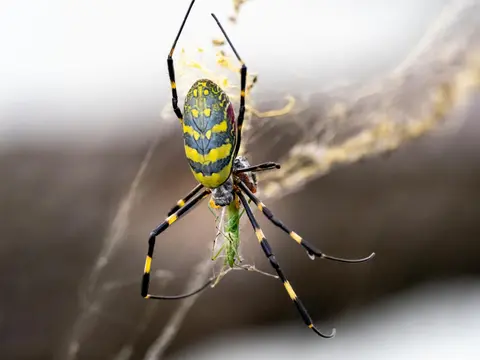
Spiders don't have to spew poison venom or display vampire-like fangs to scare the crap out of people. All they have to do is appear, and that's enough to do the trick.
Many folks, even some of the roughest, toughest dudes I've known, cower in the face of an itsy bitsy spider. It's just something about the hairy little arachnids that generates fear within us. Yuck, spiders!
Arachnophobia is one of the most common specific fears people report, and it is unusual in that it does not require a dangerous animal to trigger it. In most of the United States the spiders people meet indoors are harmless, which is part of why the fear is so often out of proportion to the actual risk.
Imagine my anxiety when I spotted a piece on Fox News Digital that warned, "Spiders the size of a human hand are spreading throughout the US."
The human hand? As in an adult human hand? That's pretty big.
"This eight-legged creepy species, known as the Joro spider, can grow as large as a human hand and has been spotted in at least eight states since 2021, including Georgia, Tennessee, North Carolina, South Carolina, California, Virginia, Maryland, and Pennsylvania," according to Fox.
A hand-sized measurement usually refers to legspan rather than body length, and in this species it is the females that reach it. Males stay far smaller, which is typical of orb-weaving spiders and is why the dramatic sightings almost always involve a female sitting in the middle of a large web.
Well, add one more state. Massachusetts."A Joro spider has made it to Massachusetts," reported CBS Boston in September 2024. "The giant venomous arachnid was spotted in Boston's Beacon Hill neighborhood."
Beacon Hill is dense, old, urban Boston, which is a good illustration of how these animals move. An invasive spider does not need suitable habitat to be walked in — it arrives on vehicles, in shipments, or on the wind — and a city is as likely a landing point as a forest.
WCVB-TV 5 confirmed the sighting. "The Joro spider, an invasive species, originally from East Asia, has made its first confirmed appearance in Massachusetts, marking its northernmost sighting in the United States," the station reported.
How far north they can establish themselves is the open question. Spreading by ballooning gets them to new places, but whether a population survives a New England winter is a separate matter, and that is what determines whether sightings in Massachusetts become an established presence or a series of one-off arrivals.
Those reports were in 2024. Imagine how many of those things are here now?
The honest answer is that nobody knows, because there is no systematic count. Reports of invasive species usually rise after media coverage simply because more people are looking and know what to photograph, so an increase in sightings is not the same thing as an increase in spiders.
"The spider is spreading through a process known as 'ballooning,' in which the young Joro spiders release a thread of silk that can be captured by the wind, allowing them to be lifted to new locations," according to Fox. "This process allows them to travel for relatively long distances, similar to other spider species." Oh goodie!
Ballooning is not unusual. Many spider species disperse as spiderlings by releasing silk and letting the wind carry them, which is how spiders colonise islands, rooftops and gardens, and how they turn up in places no adult could have walked to. For an animal with no wings, it is a remarkably effective way to cover ground.
Oh, and did I mention the Joro spider can lay between 400 and 500 eggs at a time?
A clutch of that size is normal for a large orb-weaver, and it is worth putting it in context: most of those eggs and spiderlings will not survive to adulthood. High output is how a species with no parental care compensates for very high mortality.
The web is the part people notice first. Female Joro spiders build large, dense orb webs that can span several feet, often strung between trees, along utility lines or across footpaths, and the silk has a golden tint in sunlight. Webs strung across a path or over a garden generate more complaints than the spider itself does.
Experts say that while Joro spiders have venom, their bites are not deadly to humans but can result in an allergic reaction.
That assessment matches what is generally said about the species: the venom works on insect prey, and a bite to a person is comparable to a bee sting for most people, with the main risk being an allergic reaction in someone who is sensitive. The spiders are not aggressive, and being bitten generally requires handling one.
The ecological question is what they do to the spiders already living there. Joro spiders overlap in niche with native orb-weavers, and researchers have been watching whether they displace them, compete for the same insect prey, or simply add another large web to the same habitat. Whether they reduce nuisance insects enough to offset that is unproven, and it is the kind of claim that gets repeated faster than it gets tested.
Camp Danger introduces kids to spiders, pocket dragons and Vlad the Impaler
Sargassum seaweed piles up on Marco Beach as turtle season hits 162 nests
A dog spots a 3ft python under the door in Honolulu, and eight police turn up
Piedmont library's critter day brings snakes, geckos and a tortoise

Man stops mid-ride to rescue a snake hiding in his bike

Humane Society International calls for an end to the wild turtle trade