
Jonathan, the 194-year-old tortoise, named a Guinness World Records icon
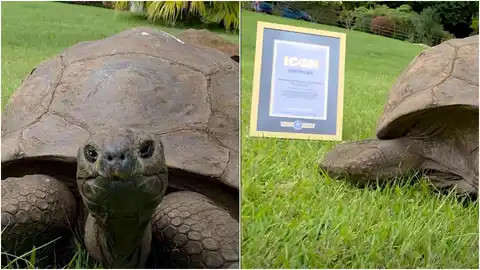
A tortoise believed to have been born nearly two centuries ago has received one of the highest honours from Guinness World Records.
Guinness World Records announced that Jonathan, the world's oldest living land animal, has officially been named a Guinness World Records ICON, recognising his extraordinary longevity and place in history.
A Guinness World Records ICON is not a new record to be broken; it is a designation applied to an existing record holder whose story has outlasted the category itself. The organisation has used it sparingly, for figures and animals whose names have become shorthand for a particular kind of achievement.
Jonathan, a Seychelles giant tortoise, is believed to have been born around 1832, making him approximately 194 years old.
Jonathan is a Seychelles giant tortoise, a group more commonly known as the Aldabra giant tortoise, native to the Aldabra Atoll in the Seychelles. Giant tortoises of this kind are among the largest land tortoises in the world, with heavy domed shells, thick columnar legs and a herbivorous diet built around grasses, leaves and fallen fruit. How he came to St Helena is part of his story: he is understood to have been brought to the island from the Seychelles in the 1880s, and has lived there ever since.
His age is an estimate rather than a documented birth date. Like all tortoises, his shell grows in rings that are sometimes used to estimate age, but the method is unreliable in older animals because the outer layers wear smooth. His roughly 1832 birth year is instead based on historical records and photographs from St Helena, including images showing him as a fully grown tortoise more than a century ago, which place him at around 194 years old.
He currently lives on the remote South Atlantic island of St Helena, where he has become both a local celebrity and a global symbol of endurance.
St Helena is one of the most remote inhabited islands in the world, a volcanic outcrop in the South Atlantic. Jonathan lives in the grounds of Plantation House, the official residence of the island's governor, where he has the run of a lawn and is looked after by the island's veterinary team. Over the decades he has become part of local life, appearing on the island's coinage and postage stamps and greeting visitors who make the journey specifically to see him.
The recognition adds to an already remarkable list of records held by the tortoise. According to Guinness World Records, Jonathan is not only the oldest living land animal but also the oldest known chelonian, the reptile group that includes tortoises, turtles and terrapins, ever recorded.
Guinness World Records reserves its ICON designation for record holders whose achievement has become part of wider cultural history, rather than simply being the current holder of a measurable category. In Jonathan's case the honour recognises both the number itself and what it represents: an animal whose life spans a period of history usually measured in human generations.
Its age is particularly notable given that Seychelles giant tortoises typically have an average life expectancy of about 150 years. He has surpassed that benchmark by several decades, allowing him to witness historical events that span generations.
Longevity of this order is unusual among land vertebrates, and giant tortoises reach it through a combination of traits rather than any single mechanism. They grow slowly and mature late, have a low metabolic rate relative to their body size, and as adults face few natural predators on the islands where they evolved. Researchers who study ageing in reptiles note that many turtle and tortoise species show what is described as negligible senescence, continuing to reproduce and showing relatively little physiological decline well into old age compared with mammals of similar size.
The tortoise's remarkable lifespan has fascinated scientists, conservationists and animal lovers around the world. Despite his advanced age, Jonathan continues to enjoy life on St Helena, where he spends much of his time grazing and resting in the island's warm climate.
Jonathan's day-to-day life is unremarkable by choice: he grazes, rests in the sun, and is fed a diet of grasses, vegetables and fruit supplemented by his keepers. He is blind, having lost his sight to cataracts, and his sense of smell is limited, but his hearing remains good and he recognises the people who care for him. His keepers monitor his weight, diet and shell condition, which is how a tortoise of this age is kept comfortable rather than merely alive.
Reflecting on the achievement, St Helena veterinarian Joe Hollins described Jonathan as a truly unique animal.
"It is extraordinary to think that this gentle giant has outlived every other living creature on land, including, of course, the whole human race," Hollins said.
Veterinary care for a giant tortoise differs considerably from that for a domestic animal. A tortoise's shell is living tissue and forms part of any health check; weight and appetite are tracked closely because they are often the first indicators that something is wrong; and the sheer size of the animal means even routine examinations are planned in advance. Hollins has overseen Jonathan's care on the island, where the animal's condition is monitored regularly.
Jonathan's latest recognition cements his status as one of the most extraordinary animals ever documented, a living link to nearly two centuries of history and a testament to the remarkable longevity of giant tortoises.
Two centuries of history is the framing that makes Jonathan unusual, but his significance for conservation is more practical. Giant tortoise populations across the Indian Ocean and the Galápagos were decimated by hunting and by the arrival of introduced predators such as rats, pigs and cats, which eat eggs and hatchlings. The species that survived did so because of protection and because of the animals' own capacity for long, slow lives — the same trait that has made Jonathan famous.
Camp Danger introduces kids to spiders, pocket dragons and Vlad the Impaler
Sargassum seaweed piles up on Marco Beach as turtle season hits 162 nests
A dog spots a 3ft python under the door in Honolulu, and eight police turn up
Piedmont library's critter day brings snakes, geckos and a tortoise

Man stops mid-ride to rescue a snake hiding in his bike
Humane Society International calls for an end to the wild turtle trade