
Five snakes with remarkable eyes, all of them dangerous
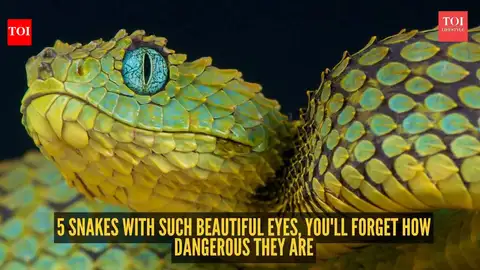
Snakes aren't usually praised for their looks. Most people notice the fangs, the scales, or the fact that they would rather not come across one in the wild.
But take a closer look at some species, and you'll find something surprisingly beautiful - their eyes. Some have bright golden eyes that seem to shine against their scales. Others have intense, jewel-like colours that make them stand out even in dense forests. Here are five snakes whose eyes are every bit as fascinating as the rest of them.
Snakes do not blink. Their eyes are covered by a fixed transparent scale, sometimes called a spectacle or brille, which is shed along with the rest of the skin at each moult — and which is why a snake's gaze never breaks. Several of the species here carry a second sensory system in the face as well: pit organs that detect infrared radiation, effectively letting them see the body heat of prey in complete darkness.
Pupil shape is the other thing worth noticing. Round pupils are common in snakes that hunt actively by day, while a vertical slit is typical of ambush predators that are active at night, because a narrow aperture gives a wide range of light control. Most of the species on this list are nocturnal sit-and-wait hunters, and their eyes are built accordingly.
The green tree python looks like it belongs on a rainforest postcard. Curled around branches with its bright green body, it is already a stunning sight. Its eyes make it even more impressive. The golden-yellow colour stands out sharply against its green scales, making the snake look almost painted by hand.
The colour is not fixed at birth. Green tree python hatchlings emerge in yellow, red or brick tones and turn green as they mature, which is part of why the species confused early collectors. Adults hunt at night from a coiled posture on a branch, with the head held below the loop, waiting for small mammals and birds to come within reach.
One look at an eyelash viper and it's easy to see how it got its name.
Tiny scales above its eyes look like eyelashes, giving the snake an appearance unlike most others. Its eyes, paired with bright colours ranging from yellow to green, make it one of the most photographed snakes in the world.
The scales that give the species its name sit above each eye and are thought to help break up the outline of the head against foliage. Like other pit vipers it has a heat-sensing organ between the eye and the nostril, and it hunts by sitting still — a sit-and-wait predator that relies on camouflage and a fast strike rather than pursuit. Colour varies widely across its range, which is why photographs of the species can look like different animals entirely.
The emerald tree boa is famous for its rich green colour, but its eyes deserve just as much attention. Large and golden, they create a striking contrast against the rest of its body. In many photographs, they are the first thing people notice.
Like the green tree python, it is an arboreal constrictor that spends its days coiled on a branch and hunts after dark, and the resemblance between the two is a textbook case of convergent evolution — unrelated lineages arriving at the same body plan because they live the same way. It also carries heat-sensitive scales along its lips.
The Gaboon viper is known for blending into its surroundings, especially among dry leaves on the forest floor.
Yet even with its impressive camouflage, its golden-brown eyes often stand out. They add a surprising touch of beauty to one of Africa's most remarkable snakes.
It is among the heaviest vipers in the world and has the longest fangs of any snake, which suits a hunting style built around a single decisive strike rather than a chase. The pattern is precisely the point: the geometric markings break up the animal's outline in leaf litter so effectively that the snake is usually noticed only when it chooses to move.
The bush viper already looks unusual because of its rough, almost spiky scales. Add bright amber or golden eyes to the mix, and the result is a snake that looks like something from a fantasy story. Its appearance is so unique that it hardly seems real.
The spiky look comes from strongly keeled scales — each one ridged down the middle — which give the body a matte, textured surface rather than the glossy appearance most snakes have. They are small, slow-moving ambush hunters that typically sit in low vegetation, and their venom is medically significant, which is worth stating plainly for a genus that appears so often in photographs.
Images: Canva (for representative purposes only)
Beautiful eyes on a dangerous animal is an uncomfortable combination, and it is worth being clear about what these species are. Every snake here except the two constrictors kills its prey with venom, and the sizeable ones do it efficiently. Admiring them through a photograph, or from a safe distance with someone who knows the animal, is the only sensible version of appreciation.

Camp Danger introduces kids to spiders, pocket dragons and Vlad the Impaler

Sargassum seaweed piles up on Marco Beach as turtle season hits 162 nests
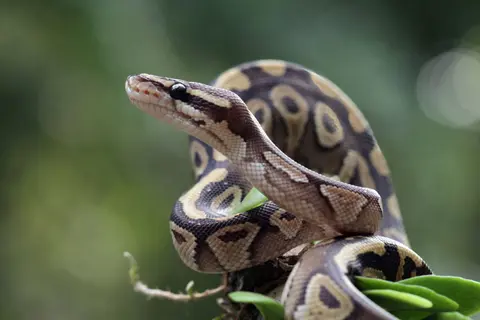
A dog spots a 3ft python under the door in Honolulu, and eight police turn up
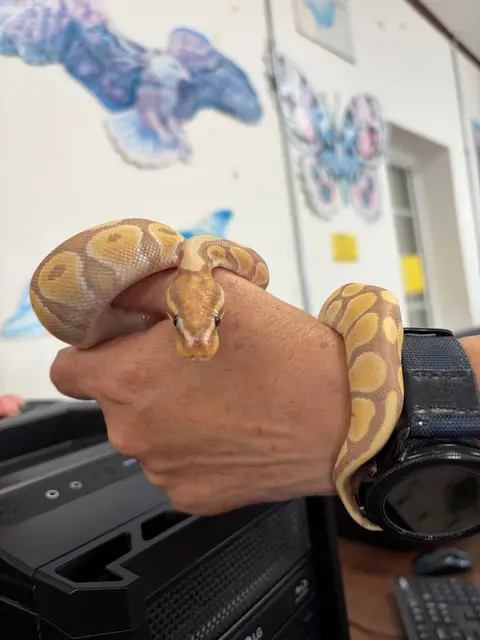
Piedmont library's critter day brings snakes, geckos and a tortoise

Man stops mid-ride to rescue a snake hiding in his bike

Humane Society International calls for an end to the wild turtle trade