
Four belugas bound for Shedd Aquarium from the closed Marineland, report says
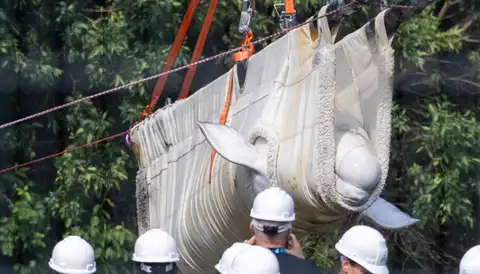
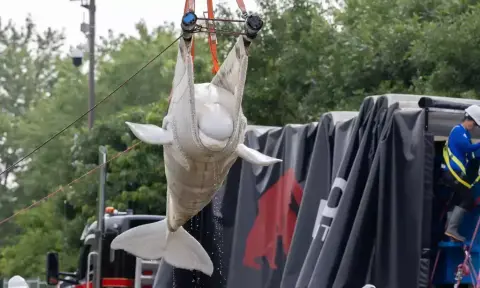
Four beluga whales from a shuttered aquatic park in Niagara Falls, Canada, were on their way to Shedd Aquarium Monday as part of an "unprecedented rescue effort," according to Canadian media.
Moving a beluga is not like moving a smaller marine mammal. An adult is several metres long and weighs the better part of a tonne, and the animal has to be lifted out of water, supported, kept cool and kept wet for the entire journey. Transfers of this kind are done with a sling and a specially fitted crate, a veterinary team travelling with the animal, and a receiving pool prepared and waiting, which is why the receiving institutions say almost nothing until the animals have actually landed.
Two more whales were headed to SeaWorld in San Antonio Monday, according to The Canadian Press.
It's the first phase of a plan to move up to 30 belugas over the next few weeks from Marineland to several American aquariums as well as to Oceanografic Valencia in Spain. Earlier this month, Shedd announced it could receive as many as 10 belugas from Marineland.
Spreading the animals across several institutions is a practical necessity rather than a preference. No single aquarium has the habitat space to absorb thirty belugas at short notice, and dividing the group also limits the risk that a problem at one facility affects all of them. It is the same logic that governs how zoos move animals between accredited collections generally: the receiving sites are chosen for capacity and for the expertise on hand.
Shedd officials declined Monday to offer a timeline for when the whales would arrive at the aquarium or to confirm Canadian press reports that they were in fact on their way to Chicago.
"As reported, an initial rescue of the belugas at Marineland of Canada is under way. This is a complex rescue operation and experts are focused on the immediate safety and comfort of the animals involved. The group of accredited aquariums will share more details and updates as animals arrive safely to their new homes," said Kayley Galassini, Shedd's director of public relations.
The refusal to confirm anything while a transport is under way is standard for accredited facilities. An aquarium that announces a movement before it is completed invites speculation if it is delayed, and a planned transport can be turned back by weather, by mechanical problems or by how the animal is coping, none of which the institution can control once the truck has left.
The belugas headed to Shedd are named Sierra, Acadia, Osiris and Lillooet, The Canadian Press reported.
The future of the beluga whales has been in doubt since Marineland closed to the public in 2024. Marineland has previously threatened to euthanize the sea mammals, citing a lack of funding to care for them.
That threat is what turned the situation into an international one. Euthanising healthy animals is not permitted under the accreditation standards that North American aquariums operate under, and a facility that said publicly it could not afford to feed its animals made it impossible for the sector to stay uninvolved. The transfers now under way are the alternative that was assembled in response.
In June, the Canadian government signed off on the plan to send the belugas to the American and Spanish aquariums. Earlier this month, U.S. authorities followed suit and signed off on the plan.
Two governments signing off is what makes an international transfer of this kind lawful. Marine mammals moving across a border fall under export controls on one side and import permitting on the other, and the approvals have to line up before a single animal can be loaded. The gap between the Canadian decision in June and the American one this month is the ordinary time such parallel processes take.
Twenty whales -- 19 belugas and one killer whale -- have died at Marineland since 2019, according to provincial government data obtained through freedom-of-information laws and official statements, the Associated Press reported.
The planned move to the aquariums is controversial, with some animal rights advocates arguing that the belugas are being exported potentially in violation of a 2019 Canadian law that bans the breeding of marine mammals in captivity.
The objection is about what happens after the animals arrive rather than about the rescue itself. Advocates are not arguing that the belugas should have been left at a closed park without funding; they are arguing that a law intended to end the keeping of captive marine mammals should not be used to stock accredited aquariums elsewhere. Supporters of the transfer respond that the animals already exist and need somewhere to live, and the disagreement is not one that the transfer itself resolves.
For the animals, the immediate question is simpler than any of that: whether they settle. Belugas moved between facilities go through a period of adjustment to a new pool, new keepers and a new social group, and the accredited aquariums involved have said their teams will monitor them closely on arrival rather than put them straight on display.

Seabirds feed the reef fish below them; take the birds away and the food chain shifts
A second tongue-eating parasite turns up in Mexican snapper

An underwater proposal at Cape Town's Two Oceans aquarium wins hearts
First known transmissible cancer found in catfish
Six of Marineland's 30 belugas airlifted to safety

MPA Day returns, with events across South Africa's marine protected areas