
First known transmissible cancer found in catfish
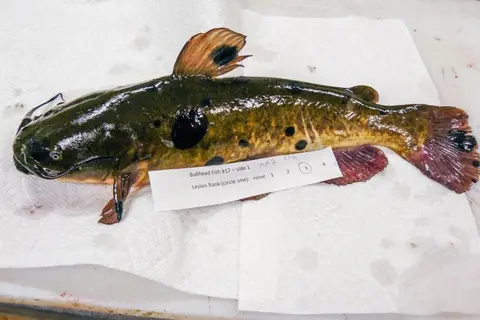
(NewsNation) -- Deep in Lake Memphremagog, sitting between the border of Vermont and Quebec, scientists from Vermont's Fish and Wildlife made a startling discovery.
Between 2012 and 2013, anglers reported finding tons of brown bullhead catfish they pulled from the lake with distinct black spots on its bodies. Once biologists got a chance to look at them, they discovered the catfish had melanoma, a type of skin cancer.
Brown bullhead are a common North American catfish, a bottom-dwelling species that tolerates low-oxygen and turbid water, which is why they are widespread in lakes and slow rivers across the region. Anglers are often the first to notice that something is wrong in a population, because they handle far more fish than a survey crew ever will.
The findings, published in the scientific journal Nature, revealed 23% to 37% of the catfish sampled had melanoma lesions. Biologists pointed out the marks can sometimes be found on their gills, lips or even covering their eyes.
A prevalence range of that order is high for a wild population. Melanoma in fish is not unknown, but finding it on roughly a quarter to a third of sampled animals points to something moving through the population rather than arising independently in each individual.
Where the lesions appear matters diagnostically. Growths on the fins, inside the mouth and across the eye are functionally significant for a fish: they interfere with feeding and swimming, and a growth over the eye removes the ability to find food or avoid predators. That is why a lesion that looks cosmetic from a boat can be serious for the animal carrying it.
"It looks like black tar on the skin -- not very pretty," biologist Peter Emerson with the department told NPR. "You can tell it doesn't help the fish cause they're inside the mouth, they're on the fins."
Researchers said they believe a contagious form of cancer is spreading among the fish in the lake. They said the outbreak must have started with one fish who developed a tumor, which then shed cancer cells into the water.
Once those cells invaded the other catfish, scientists believe it jumpstarted a plague.
What makes a transmissible cancer different from an ordinary one is that the tumour cell itself is the infectious agent. Instead of arising from the host's own tissue, the cancer cells are a clonal line derived from an original animal, and they spread from one individual to another as living cells — effectively a graft that grows. The tumour in a second host is genetically the cancer's, not the host's.
That should not normally be possible. A vertebrate immune system recognises foreign cells by their surface markers and rejects them, which is why transmissible cancers are so rare: for a tumour to move between individuals it has to evade that recognition, generally by downregulating the molecules the immune system uses to identify non-self tissue. It also helps if the host population is genetically similar, because the mismatch the immune system detects is then smaller.
Researchers hypothesize the cancer came from extensive flooding in 2011 from Hurricane Irene, which led to reduced water quality of the lake due to runoff pollution.
The flooding hypothesis is a correlation rather than a mechanism. A major storm in 2011 would have pushed agricultural and urban runoff into the lake, degrading water quality and potentially stressing the fish at the same time; either could plausibly have increased susceptibility or allowed an outbreak that had been smouldering to become visible. Establishing that would require comparing water quality and tumour prevalence before and after, which is rarely available for an event nobody anticipated studying.
So far, contagious tumors have only been found in a random variety of animals aside from the catfish, such as dogs, Tasmanian devils, a few different kinds of clams and some shellfish. Scientists have now been left wondering just how prevalent transmissible cancers might be, even among humans.
The known examples are few and scattered. Devil facial tumour disease has been tracked in Tasmanian devils for decades and has had a severe effect on the population; canine transmissible venereal tumour spreads by direct contact and is one of the oldest known clonal cell lines in existence; and disseminated neoplasia has been recorded in several bivalve species, where it behaves like a leukaemia in the haemolymph. Each was found more or less by accident, which is the basis for the suspicion that more exist undetected.
"This finding does reinforce the idea that transmissible cancers could emerge anywhere, including in our own species," researcher Elizabeth Murchison told The New York Times.
While scientists still research the topic, the American Cancer Society maintains cancers being spread between humans is not possible, and there's little research to indicate otherwise.
The reassurance for humans rests on a specific point. Contagion requires viable cancer cells to move from one body to another and then evade immune rejection, which does not happen through ordinary contact. Documented human cases are extraordinarily rare and have involved circumstances in which cells were transferred directly, through organ transplantation or from mother to fetus, rather than transmission in the everyday sense.
Seabirds feed the reef fish below them; take the birds away and the food chain shifts
A second tongue-eating parasite turns up in Mexican snapper
An underwater proposal at Cape Town's Two Oceans aquarium wins hearts
Six of Marineland's 30 belugas airlifted to safety

MPA Day returns, with events across South Africa's marine protected areas
Hey! That's My Fish! gets a deluxe edition, 23 years on