
Corals are thriving in San Remigio's protected waters
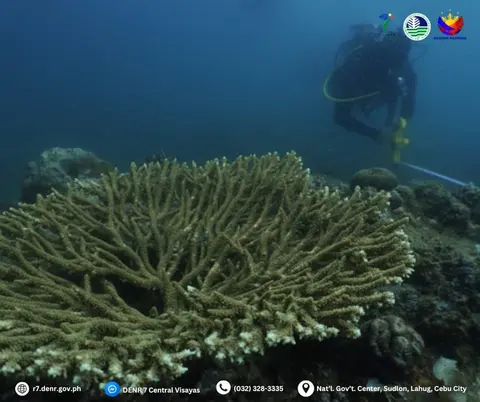
MANDAUE CITY, Cebu - Corals remain abundant in marine protected areas in San Remigio town in northern Cebu.
Coral communities dominated by Porites, Pocillopora, Acropora, and Millepora -- thrive along gently sloping, silty reef beds, thus increasing the population of reef fishes.
This was the finding of the recent joint underwater assessment led by the Coastal Resources and Ecotourism Research Development and Extension Center (CRERDEC) of the Department of Environment and Natural Resources in Central Visayas (DENR-7).
READ: BFAR-7 tells public: Stop collecting, trading corals
What the assessment found
A joint assessment by CRERDEC, in coordination with the Tañon Strait Protected Seascape Management Office and the Bureau of Fisheries and Aquatic Resources Region 7, conducted from March 16 to 20, 2026 showed that coral communities in Barangays Maño, Anapog, Busogon, Tambungon, Bancasan, Kinawahan, and Luyang continued to thrive.
Assessments of this kind typically combine dive surveys with standardised transect or photo-quadrat methods, letting teams estimate live coral cover and record which genera dominate a site. Repeating the same method over time is what turns a single survey into a trend, and trend data is what managers use to argue that a protected area is working.
The barangays surveyed
The survey covered the waters off Barangays Maño, Anapog, Busogon, Tambungon, Bancasan, Kinawahan and Luyang — a string of coastal villages along San Remigio's shoreline. Recording thriving coral across several barangays, rather than at a single site, suggests the protection is delivering results along a stretch of coast rather than in one unusually favourable spot.
What healthy coral reefs can do
Healthy coral reefs provide habitat, feeding, spawning, and nursery grounds for aquatic species, including commercially harvested fish species.
Feeding, spawning and nursery grounds
A reef is not simply a collection of coral; it is the structural framework that makes the rest of the ecosystem possible. The spaces between coral branches shelter juvenile fish, the surface of the reef supports algae and the invertebrates that graze on it, and the reef's crevices become the spawning and nursery areas on which both subsistence and commercial fisheries depend.
Why reef fish follow coral cover
Where live coral cover is high, fish abundance and diversity tend to follow, because shelter and food are both more available. That relationship is why coral cover is widely used as a proxy measure of reef health, and why the increase in reef fish noted in the assessment is read as a sign the habitat itself is functioning.
"This abundance, especially compared with areas outside, provides clear evidence that protection is effective," DENR-7 said in a report that was posted on its social media page on Wednesday, March 25.
READ: Study: 13 Cebu towns rich in live hard corals
The coral genera recorded
The four genera named in the assessment — Porites, Pocillopora, Acropora and Millepora — cover a useful spread of reef forms. Porites tends to form massive, slow-growing mounds that are relatively tolerant of sediment and temperature swings. Pocillopora forms compact branching heads. Acropora, the staghorn and table corals, grows quickly and builds much of a reef's three-dimensional structure, but is among the more fragile and heat-sensitive groups. Millepora, commonly called fire coral, is not a true stony coral but a hydrozoan, and is known for the stinging cells that give it its common name. A reef holding a mix of these forms is structurally varied, which generally supports a wider range of fish.
The assessment notes that these coral communities thrive along gently sloping, silty reef beds. Silt is normally a stressor for coral: sediment settling on a colony has to be cleared by the animal, which costs energy, and heavy sedimentation can smother polyps outright. That corals persist on silty substrate here is notable, and it suggests the sediment load in these protected waters stays within the range the colonies can tolerate.
Coastal communities
In its report, DENR-7 said that when the magnitude 6.9 earthquake hit northern Cebu on September 30, 2025, followed by Typhoon Tino in November of the same year, many of the coastal communities in northern Cebu were ruined and faced uncertainties.
"Recovery was painstaking and slow," it said.
READ: Lapu-Lapu City Hall warns dive group on coral damage
Luckily, the protected areas in San Remigio town did not incur any significant damage.
Why protected areas fared better
Healthy reefs are not immune to physical damage from storms or ground shaking, but a reef with high live coral cover and an intact fish community is generally in a better position to recover afterwards. Grazing fish keep algae in check, which leaves clean surfaces for new coral larvae to settle on, and complex structure gives juvenile fish somewhere to hide while the reef regrows. Protection also removes the compounding pressures — destructive fishing, anchoring, coral collection — that slow recovery in unprotected areas.
Why protection matters
Marine protected areas work by giving part of the coast a rest. When fishing pressure is removed or restricted inside a boundary, fish grow larger and more numerous; over time the surplus spills over into adjacent waters that are still fished, which is one of the arguments used to bring fishing communities on board. Healthy reefs also buffer the wave energy reaching the shore and underpin dive and coastal tourism.
The pressures facing these reefs have not gone away. Warming seas drive coral bleaching, storms break branching corals, sediment from coastal works and runoff smothers reef surfaces, and collection and trade remove coral directly. Findings like this one matter because they show what the alternative looks like when those pressures are held back — and give managers evidence to justify keeping protection in place.
The involvement of three agencies — CRERDEC, the Tañon Strait Protected Seascape Management Office and BFAR Region 7 — also reflects how reef management is split in practice. Research and assessment, protected-area administration, and fisheries enforcement are separate mandates, and a finding like this one only translates into protection on the water when all three are working from the same data.
Seabirds feed the reef fish below them; take the birds away and the food chain shifts
A second tongue-eating parasite turns up in Mexican snapper

An underwater proposal at Cape Town's Two Oceans aquarium wins hearts
First known transmissible cancer found in catfish
Six of Marineland's 30 belugas airlifted to safety

MPA Day returns, with events across South Africa's marine protected areas