
Seremban's stray dog bounty could encourage pet theft, activists warn
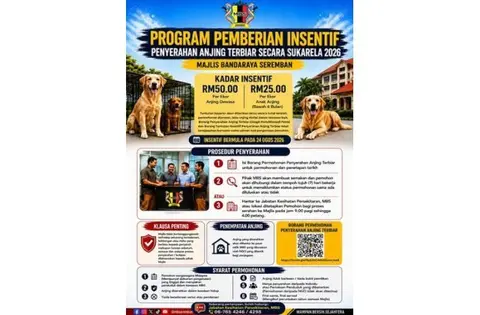
PETALING JAYA: A cash incentive scheme introduced by the Seremban City Council for surrendering stray dogs could encourage the public to capture and pass off owned pets as strays, warned Lawyers for Animal Rights (LAR).
Bounty-style payments are a familiar tool in pest control, but applying them to companion animals is contentious. The objection is not that strays should be left alone; it is that a per-head payment rewards volume rather than welfare outcomes, and gives the person handing over an animal a reason not to ask too many questions about where it came from.
Under the Program Pemberian Insentif Penyerahan Anjing Terbiar Secara Sukarela 2026, the council offers RM50 for every adult dog and RM25 for every puppy handed over.
Describing the initiative as a dangerous "cash-for-capture scheme," group called on the council to withdraw it immediately. The group noted that the policy contradicts Veterinary Services Department's guidelines, which classify animal capture as a high-risk activity requiring trained personnel.
Catching a frightened dog is genuinely difficult work. Even a normally placid animal can bite when cornered, and an unfamiliar dog that is injured, scared or protecting pups is unpredictable. This is why animal capture is usually treated as a job for trained handlers with the right equipment — catch poles, traps, transport crates and protective gear — rather than something to be attempted by a member of the public with a rope or a bag.
The risks run in both directions. A person bitten during a capture attempt faces the possibility of wound infection and, depending on the animal's vaccination status, the prospect of post-exposure treatment, while the dog itself can be injured by an improvised restraint. Municipalities that run catch programmes generally carry that risk internally, with insured staff and defined protocols; shifting it onto volunteers through a liability waiver does not remove the hazard, it only moves who bears the consequences.
"The council's own Form SA-02 requires applicants to accept responsibility for injuries or risks during capture," the group said in a statement on Thursday (Aug 13). "The council knows the risks, yet instead of deploying trained personnel, it is paying members of the public to undertake a dangerous task while attempting to shift liability onto them."
A waiver of this kind also points to a basic asymmetry. The council sets the terms, fixes the payment and defines the paperwork, while the person doing the catching takes on the physical risk. Animal welfare groups argue that if an authority has identified capture as high-risk enough to require a signed acceptance of liability, the same reasoning should rule out paying untrained residents to do it.
The group also voiced alarm over rules allowing individuals to surrender unlicensed dogs simply by declaring them ownerless.
"A dog without a licence is not necessarily an ownerless dog," the group stated, warning that the RM50 bounty provides a financial incentive for pet kidnapping.
The concern about mislabelled pets is not hypothetical. A dog that wanders out of an unfenced yard, slips its collar, or is taken from a garden can be presented at a council counter as a stray within hours, with no document required to back up the claim. Where microchipping and licensing rates are low, there is often no practical way for staff to check whether the animal in front of them has an owner searching for it.
That is why verification is the point animal welfare groups keep returning to. A microchip scan takes seconds and returns a registered owner, and cross-checking a surrendered animal against recent lost-pet reports costs little. Without those steps, a scheme has no way to distinguish a genuine stray from a stolen pet, and the incentive structure actively rewards not looking.
The group questioned whether the council has safeguards in place, such as microchip checks or lost-pet verification, and criticised the council for excluding experienced animal welfare NGOs in favour of public bounties.
Animal welfare organisations say they are used to being asked to help with exactly this kind of work — trapping, sterilising, vaccinating and rehoming — and that a bounty sidelines the groups with the most experience in favour of whoever can bring in the most animals. Their argument is that population control comes from sterilisation rather than removal: taking dogs off a street without reducing breeding simply opens space for new animals to move in.
The group urged the Negeri Sembilan DVS and the Housing and Local Government Ministry to investigate who approved the scheme and why capture operations were outsourced to untrained citizens.
The call for an investigation is aimed at the approval process as much as the policy itself. Local councils in Malaysia operate under state and federal oversight, and animal matters sit with the Veterinary Services Department, so a programme of this kind raises straightforward questions about which guidelines were applied, who signed off on the payments, and whether any alternatives were considered before the bounty was announced.
"Malaysia has just witnessed the tragic consequences of an animal-capture operation involving Rocky," the statement added. "The lesson should be clear: animal capture must become more professional and humane, not a cash bounty system."
What happens next will likely depend on whether the council amends the scheme or defends it. The specific changes activists have asked for are narrow: withdraw the payment, put capture back in the hands of trained personnel, and add ownership checks before any animal is accepted. Those are procedural fixes rather than a rejection of stray management itself, and they would leave the council with a programme that is considerably harder to abuse.
Thiruvananthapuram's stray dog relocation drive faces questions over transparency
Rain shows up the flaws in Inverloch's dog park
Fixing the street dog problem means working with animal welfare groups
Dogs take over the fairgrounds for the Lost Coast Kennel Club show
Ulster County SPCA shares a happy update on the Yorkie rescued from a breeding case
Meet Toffee, the husky-dalmatian mix who's also an escape artist