
Thiruvananthapuram's stray dog relocation drive faces questions over transparency
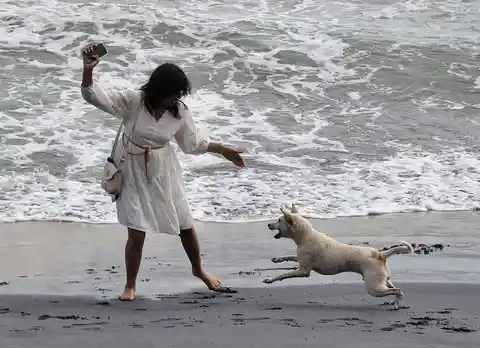
A stray dog attacks a visitor at Kovalam beach on TuesdayB P Deepu
For years, stray dogs have remained one of the most debated civic issues in Thiruvananthapuram. Today, however, it has taken a more complex turn.
While the corporation says it has found a remedy, some animal welfare groups allege that the measures lack transparency.
The central question is no longer whether the problem exists, but how to resolve it humanely.
That framing reflects a legal position rather than a matter of opinion. Indian law does not permit street dogs to be culled or driven out of an area, and the mechanism the state provides is sterilisation and vaccination followed by return to the same locality. Any municipal action has to operate inside that framework, which is precisely why the question of where dogs end up after being picked up is the one animal welfare groups keep returning to.
Kerala's stray dog question has been sharpened by a series of court directions over recent years and by bite and rabies figures that keep the issue politically live. A corporation under pressure to show results has an incentive to report numbers removed, and a removal target is the kind of metric that can be met in ways a sterilisation target cannot.
Most residents oppose the presence of street dogs in their neighbourhoods, though a committed group of community feeders continues to provide food, water and veterinary care.
Between these opposing positions lies the challenge of finding a solution that protects both public safety and animal welfare.
The two groups are not as far apart as the framing suggests. Feeders are usually the people who get dogs sterilised and vaccinated at their own expense, and they are often the ones who know which animals in a locality have already been through an ABC centre. Residents who want fewer dogs on the street and feeders who want those dogs protected are, in principle, asking for the same programme at a scale that actually works.
What concerns animal rights groups most is what they describe as the "mystery" surrounding dogs removed from city streets.
"There is no transparency about where the dogs are taken after they are picked up. Even staff at some Animal Birth Control (ABC) centres claim they do not know," says Sreedevi S Kartha, secretary of Peoples For Animals (PFA), one of the two Animal Welfare Board-certified NGOs operating shelters in the city.
"Dogs are brought in for sterilisation and vaccination, after which they are taken away in vans that arrive at night. Where they go and how they are kept remains unknown."
Night-time collection is the detail that gives the allegation its force. Sterilisation and release programmes normally operate in daylight with records that can be inspected, because the point of the programme is that the animal is returned to where it was taken from. Transport after dark to a destination neither the centre staff nor the volunteers can identify is exactly the pattern that would make an audit impossible even if one were requested.
Sreedevi says volunteers attempted to trace the destination of the dogs and located a private farm near Kottoor, on the fringes of a forest.
"We found a seven-acre compound with about 11 dogs. Local residents told us they had seen vehicles bringing dogs there," she says.
A site of that kind raises the practical question of capacity. Eleven dogs on seven acres is a small number, and a compound on the edge of a forest is an odd choice for sheltering animals seized from city streets, where the usual expectation is that they are held at a registered facility and returned. What volunteers could establish was that vehicles had been seen arriving, which is enough to ask the question and not enough to answer it.
There are also allegations that dogs are being culled. "If that is true, it is heinous and contrary to Animal Welfare Board guidelines as well as Supreme Court directives," says advocate
The reference to Animal Welfare Board guidelines matters because those guidelines set out how a sterilised dog is supposed to be handled, including the expectation that it is returned to the territory it was taken from. A departure from them is a compliance question as much as a welfare one, and it is the basis on which any challenge would be brought.
Sreelatha Nair, who has been associated with animal rights groups.
She notes that the court's position has evolved over time. While it had earlier prohibited the release of sterilised dogs back into public spaces, subsequent orders permitted the return of healthy, non-rabid dogs in certain circumstances.
That evolution is the reason the argument is now about process rather than principle. With the return of sterilised dogs settled as the lawful outcome, the only remaining question in a case like this one is whether the corporation is actually doing what it says it is doing — and an answer that cannot be checked by the certified NGOs operating the shelters is not an answer at all.
What the welfare groups are asking for is not complicated. A register of dogs picked up, the facility each one went to, and the outcome — sterilised and returned, or otherwise — would settle the question quickly, and its absence is what keeps the allegation alive.
Rain shows up the flaws in Inverloch's dog park
Fixing the street dog problem means working with animal welfare groups
Dogs take over the fairgrounds for the Lost Coast Kennel Club show
Ulster County SPCA shares a happy update on the Yorkie rescued from a breeding case
Meet Toffee, the husky-dalmatian mix who's also an escape artist

Dogs notice when the clocks change, even if they can't tell the time