
Langley Township wants your views on its dog park redesign
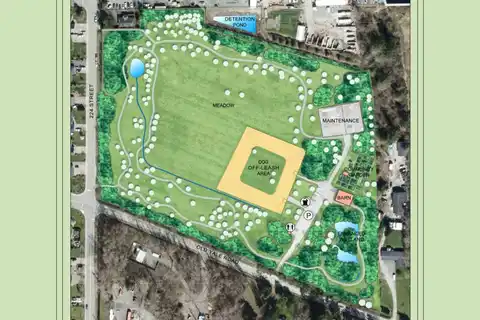
The Old Yale Dog Park survey option 3 calls for designated space for small dogs, and big dogs, as well as an area where dogs of any size can play. (Township graphic)
Users of a dog park in Murrayville can help determine whether the revamped design allows all dogs to mingle or keeps dogs in areas designated by size.
Langley Township is surveying the public about the Old Yale Dog Park at Old Yale Road and 224 Street. The 4,770 m² dog park was built in 2015 in a natural wetland area.
Dog parks of this kind tend to be heavily used, and the way they are laid out shapes how safe and comfortable people find them. A single open enclosure is simple to build and supervise, but it puts a large energetic dog and a nervous small one into the same space, which is the situation many owners are most wary of. Separating by size is the more common alternative, and it is usually the option that gets requested when a park has been running for a few years and regulars have formed a view about what is not working.
Since its establishment, staff have undertaken ongoing maintenance and rehabilitation to address long-standing drainage issues, including raising the park elevation, installing permeable substrate, topping with turf blend soil, and re-establishing perimeter bioswales.
Drainage is the recurring problem at off-leash parks built on low ground. Grass in a wet enclosure does not recover between visits: wear concentrates at gates and along the fence line, the surface turns to mud, and the park becomes unpleasant to use for much of the wet season. Permeable substrate and raised elevation are meant to move water off the surface rather than let it sit, and bioswales around the perimeter take the runoff and let it soak away gradually instead of pooling.
In 2025, additional upgrades were completed in the remaining areas of the park, including the installation of new trees, benches, and pathways, as well as the use of rolled turf to improve erosion control and support faster site establishment.
Shade and seating matter more at dog parks than at most other parks, because people stay for a while rather than passing through. Trees also take up some of the load on the grass surface by giving the ground a break in the areas under their canopy, and defined pathways keep foot traffic off the parts of the enclosure that need the longest to recover.
As part of the process, the Township wants to hear from dog people about how they want the space assigned, and is looking at three options.
Option 3: three designated zones: a big dog area, small dog area, and an all-dog area
An all-dog area alongside two size-restricted ones is a compromise that has become more common. It gives owners of small or elderly dogs a space where they are not sharing with much larger animals, and it keeps an option open for households with more than one dog of different sizes, or for a dog that simply plays better in a mixed group.
The options include a six-foot buffer between fence lines to reduce "fence frustration."
Fence frustration, or barrier frustration, can occur when a dog is separated from something it wants to reach - most often another dog - by a physical barrier like a fence. At dog parks, this typically occurs when dogs are inside or outside the park and can see, smell or hear other dogs but can't interact with them. This can result in dog behaviours including excessive barking, growling, whining, running along the fence line, jumping, or biting at the fence.
A buffer of that width is essentially a design acknowledgement that the behaviour is caused by proximity. Dogs that can stand nose-to-nose through a single fence are far more likely to react than dogs that are kept several feet apart with a gap they cannot cross, and the running and barking along a shared fence line is also the part of the problem most likely to disturb neighbours of the park.
How the space is divided is also a question of how much each zone gets used. A park with three zones has to allocate area between them, and if a small dog area is sized too generously relative to demand it sits empty while the rest is crowded, which is the kind of detail a survey of actual users can settle better than a design assumption.
There is also a behavioural argument that cuts the other way. Dogs separated by size for every visit never get the chance to learn how to read a much larger or much smaller dog, and the owners of well-socialised small dogs sometimes prefer a mixed area precisely because that exposure is the point. A three-zone layout lets both groups make that choice for themselves rather than having the park decide it for everyone.
The Township has an online survey. Anyone wanting to provide input must complete the survey by March 29. Questions about the survey and dog park can be directed to [email protected].
Municipal surveys of this type are usually short and focused on a single decision, in this case which of the three layouts to build. Because the work follows years of drainage and surfacing repairs, the consultation is about internal layout rather than whether the park stays, and responses from people who actually use the park carry more weight than general opinion about dog parks.
Thiruvananthapuram's stray dog relocation drive faces questions over transparency
Rain shows up the flaws in Inverloch's dog park

Fixing the street dog problem means working with animal welfare groups
Dogs take over the fairgrounds for the Lost Coast Kennel Club show

Ulster County SPCA shares a happy update on the Yorkie rescued from a breeding case

Meet Toffee, the husky-dalmatian mix who's also an escape artist