
Police in Ho Chi Minh City stop two trucks carrying over 200 pigs positive for salbutamol
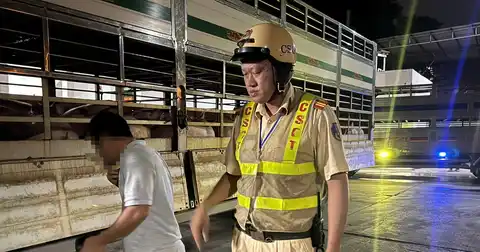
Traffic police in Ho Chi Minh City intercepted two trucks transporting 201 pigs that tested positive for the banned substance Salbutamol while en route to slaughterhouses, authorities said on July 28.
The Rach Chiec Traffic Police Team under the HCMC Traffic Police Division, in coordination with the Thu Duc Animal Quarantine Station, processed two trucks transporting 201 pigs that tested positive for the banned substance Salbutamol while being transported into HCMC for slaughter on July 28.
The violations were uncovered on July 26 during a joint inspection of vehicles transporting livestock and food products along National Highway 1. The Rach Chiec Traffic Police Team and an inter-agency task force inspected 15 trucks carrying livestock, poultry, and frozen food passing through the area.
That two of fifteen inspected vehicles were carrying contaminated animals is worth noting in itself. Roadside inspection of livestock trucks is necessarily a sampling exercise: officers cannot test every animal on every vehicle, so the checks concentrate on documents, on visibly unwell animals, and on rapid tests where there is reason to run one. National Highway 1 is the main north-south corridor into the city, which makes it a practical place to intercept animals being brought in for slaughter.
Authorities found one truck driven by V.N.H., 40, from Lam Dong Province, transporting 86 pigs, and another driven by T.K.B., 42, from Vinh Long Province, carrying 115 pigs. Both vehicles were traveling from Dong Nai Province to Dong Hoa Ward in HCMC to deliver the pigs for slaughter.
The drivers presented animal quarantine certificates issued by the Dong Nai authorities on July 26, along with documents verifying the livestock's origin.
The paperwork being in order is the part of the case that explains why the stop mattered. A quarantine certificate confirms that animals were inspected and cleared for movement at their point of departure, and in this instance the certificates were issued the same day the trucks were stopped. Documentation of this kind does not screen for residues of growth-promoting compounds, which is why rapid testing on the vehicle is used alongside it rather than instead of it.
However, rapid tests conducted by veterinary officers found that all 201 pigs tested positive for Salbutamol.
Every animal on both trucks testing positive points to the source rather than to chance contamination in transit. When a whole consignment comes back positive, the usual explanation is that the compound was administered at the farm, most often through feed or water in the period before sale, rather than something that happened to individual animals on the road.
The inspection team documented the violations, escorted the trucks to a specialized testing facility for further examination and verification, and transferred the case to the Thu Duc Animal Quarantine Center for handling in accordance with regulations.
Confirmatory testing at a specialist facility is the step that turns a roadside result into an enforceable case. Rapid tests are screening tools designed to be fast and usable at the roadside, and a positive result is normally followed up with laboratory analysis that identifies and quantifies the residue before penalties are applied.
According to authorities, Salbutamol is a pharmaceutical ingredient used to treat asthma and other respiratory conditions but is prohibited in livestock production because it promotes lean muscle growth and reduces fat in animals.
Compounds of this class are attractive to producers because they change the carcass rather than simply adding weight: more lean tissue and less fat means a better price at sale for the same amount of feed. That is precisely why they are banned for food animals, since the economic incentive to use them is built in and the residue stays in the meat.
Residues of Salbutamol in food may pose health risks to consumers, including rapid heartbeat, muscle tremors, elevated blood pressure, and adverse cardiovascular effects.
These effects are the predictable result of a bronchodilator reaching someone who was never prescribed it, and they are the reason residue limits matter more than the visible condition of the meat. A pig that has been dosed looks healthy and passes ordinary visual inspection at the slaughterhouse, which is why testing has to happen before the animal enters the food chain rather than after.
Under Vietnamese law, the use of Salbutamol as a growth-promoting agent in livestock is strictly prohibited and subject to legal penalties.
Enforcement in cases like this one runs on several tracks at once: the animals are dealt with under veterinary and food safety rules, while the movement of a banned substance through the supply chain can also attract criminal liability. Where a consignment is intercepted before slaughter, the practical outcome is that the animals do not reach the market at all.
For the buyer, the risk sits exactly where consumers cannot protect themselves. Meat from a dosed animal looks, smells and cooks like any other, and residues of this type are not reliably removed in the kitchen, so no household or restaurant can screen for it at the point of purchase. That is the argument for testing animals before slaughter rather than inspecting carcasses after it.
Pork is the staple meat in Vietnam, and Ho Chi Minh City is the country's largest consumption centre, so animals are trucked in daily from rearing provinces such as Dong Nai. Supply chains of that volume are difficult to police by inspection alone, which is why roadside checks and rapid testing remain the main practical check on what enters the city.
By Nguyen Tan - Translated by Thuy Doan
Veterinary department culls 31 pigs at Rohit Sahu's farm
Illa Langi's paddock-to-plate pork is starting to pay off

The time Sam Neill did yoga with his pig

This World Cup season, the goal is stopping African swine fever

Feral pigs tear through farmland in New South Wales
Cull of 19,000 pigs begins as parliament meets over the foot-and-mouth crisis