
Yilo Krobo hands out local chickens under a government food programme
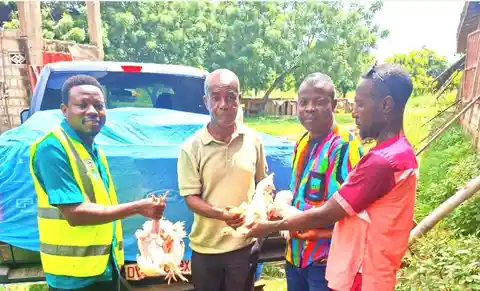
The Yilo Krobo Municipal Assembly has distributed part of a 10,000‑bird consignment of local chickens to residents in Somanya to boost household incomes and strengthen food security under the national Feed Ghana Programme.
A distribution aimed at households
The intervention targets smallholder farmers, women's groups, and youth associations, providing them with resilient indigenous birds to enhance local poultry production and expand livelihood opportunities across the municipality.
Backyard and household poultry has long been a quiet mainstay of rural livelihoods in Ghana. A small flock costs little to keep, converts kitchen scraps and scavenged insects into protein, and can be sold quickly when a family needs cash for school fees, medical bills or farm inputs. Unlike large commercial operations, a backyard flock does not require expensive housing or a steady supply of formulated feed, which is why programmes built around household birds tend to reach people who would otherwise be left out of formal agricultural credit.
Distributing birds rather than cash also has a practical logic: a flock is an asset that can grow. Beneficiaries who reinvest their first offspring into a larger flock can move from a handful of birds to a small enterprise within a couple of seasons, and the surplus birds and eggs that follow feed both the household and the local market.
The Nkoko Nkitinkitin programme
The initiative dubbed, Nkoko Nkitinkitin, launched in 2025, is the ruling National Democratic Congress government's flagship household and backyard poultry programme.
It is designed to revitalise the country's poultry industry by distributing millions of indigenous birds to reduce chicken imports and enhance national food security.
Programmes of this kind sit at the intersection of two national goals: raising rural incomes and cutting the import bill for poultry meat. Ghana has historically imported significant volumes of frozen chicken, and policymakers have repeatedly argued that strengthening domestic production keeps more of that spending inside the local economy while giving farmers a more reliable market for their birds.
Why indigenous breeds were chosen
Indigenous or local chickens are generally hardier than imported commercial breeds. They are adapted to the local climate, forage effectively, and survive on a more varied diet, which suits a backyard system where birds largely feed themselves. The trade-off is that they grow more slowly and produce fewer eggs than specialised commercial hybrids, so the programme's emphasis is on resilience and low input costs rather than maximum output per bird.
Why the birds were brooded for six weeks
Mr. Francis Addo Akumatey, the Municipal Chief Executive, told the Ghana News Agency (GNA) that the birds were brooded for six weeks instead of the standard four to improve survival rates.
Brooding took place at Jireh Farm at Okwenya, Nazareth Farm at Akorley, and Joe Farms.
The extra two weeks matter because the first days of a chick's life are the most fragile. Young birds cannot regulate their own body temperature effectively and depend on external warmth, steady access to clean water, and protection from predators and damp. Handing over birds that have already passed through that vulnerable window substantially increases the chances that they will establish themselves in a new backyard rather than being lost in the first week.
Brooding the consignment at established farms also allowed the birds to be vaccinated and observed as a group before distribution, rather than leaving disease control to individual households with no veterinary support.
Who received the birds
He said 15 poultry farmer associations received 150 birds each, while individual household farmers were allocated 50 birds.
More than 100 residents applied to benefit from the initiative.
Working through associations rather than only through individual applicants spreads both the risk and the workload. Groups can pool labour for housing, buy feed in bulk, and share transport to market, while individual household allocations keep the programme reachable for people who are not part of any formal farmers' organisation.
Training and aftercare
Agriculture officers trained beneficiaries on poultry housing, feeding, vaccination, and hygiene, encouraging them to reinvest in their stock to ensure sustainability.
Mr Akumatey said the intervention would help expand local poultry production using resilient indigenous breeds while creating sustainable livelihood opportunities for households.
Housing and hygiene
Basic housing requirements are modest but non-negotiable: a dry, draught-free shelter raised off the ground, bedding that is changed regularly, and a nighttime enclosure that keeps birds safe from predators. Simple hygiene routines — separating sick birds, cleaning feeders and drinkers, and limiting visitors to the flock — do more to prevent losses than most treatments available after an outbreak has begun.
Vaccination and disease prevention
Vaccination is the single most important part of the training. Viral diseases can spread quickly through a scavenging flock and through the shared water points that birds use in a village setting, and losses tend to arrive suddenly and in large numbers. Beneficiaries who follow the vaccination schedule and report unusual deaths promptly give agriculture officers a chance to contain a problem before it reaches neighbouring flocks.
What beneficiaries are saying
Some beneficiaries, including Madam Gladys Teiko, expressed appreciation for the gesture, describing the support as timely and impactful.
What the programme is expected to deliver
The assembly said the programme is expected to increase access to protein, boost local poultry supply, and reduce reliance on imported chicken.
Whether a distribution of this kind succeeds is ultimately measured a year or two later, not on handover day. The indicators to watch are straightforward: how many of the distributed birds are still alive and laying, how many households have grown their original flock, and how much of the local market for poultry is supplied by birds raised within the municipality itself.
At least 655 pigeons shot at London Tube stations during a cull
The seven-year-old behind the viral bird calls reveals what's next
What a trip to the Falklands taught me about penguins
One simple change will keep small birds coming to your birdbath all summer
Pigeons cracked a problem built to defeat rule-followers, and it says something about AI
Florence County Library brings in an exotic animal rescue