
Spotted towhees at the bird feeder in Golden Hills
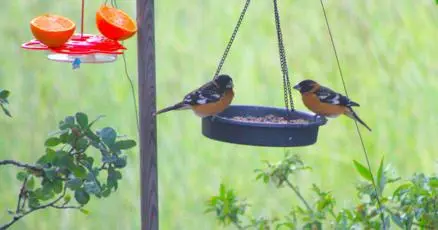
Tim Crouch took this photo of two Spotted Towhees (Pipilo maculatus) at his Golden Hills home as they were eating seeds on one of Tim's bird feeders.
Photographs of this kind are what the column exists for. A feeder bird is more often heard than seen, and a species that spends most of its time under a shrub is one most people in the neighbourhood never get a clear look at, however often it visits. Two birds on a feeder together is also an unusual frame, since towhees are territorial enough that they rarely tolerate each other at close range outside the breeding season.
Spotted Towhees are actually a type of sparrow, one of 20 different sparrow species that have been recorded in the Tehachapi Mountains. The word towhee is typically pronounced "toe-ee," with the "w" and "h" silent.
Being counted among the sparrows is a matter of classification rather than appearance, since a towhee is considerably larger and far more boldly marked than the small streaked birds most people picture when they hear the word. The name itself is onomatopoeic, taken from the bird's call, which is why the spelling and the pronunciation have drifted apart.
There is another towhee species, the California Towhee, which is much more common in this area. California Towhees are an overall brown-gray color with cinnamon colored underparts.
Telling the two apart is straightforward once you know what to look for. The Spotted Towhee has white spots on the wings and back, white outer tail feathers that flash when it flies, and a black head and upper body set against a rusty flank and a white belly. The California Towhee has none of that contrast: it is the plain brown bird with a warm cinnamon patch under the tail that people often describe as a large, drab sparrow. In the Tehachapi area the spotted bird is the one that draws attention.
Towhees like to forage for seeds on the ground, and they have the classic bill shape of seedeating birds: short, thick and stout. In yards like Tim's with birdseed feeders, towhees are often found on the ground, foraging for the seeds that have been scattered by other birds.
That habit is why a towhee shows up in a yard with feeders at all. It is rarely the bird on the feeder itself; it is the bird underneath it, working through what the finches and jays have knocked to the ground. Anyone wanting to see one well is better off scattering a little seed on bare ground or leaving a patch of leaf litter undisturbed than adding another hanging feeder.
Towhees frequently hold their feet side by side and hop backwards while scratching in leaves and duff to uncover hidden seeds.
It is a distinctive enough movement that it is the best field mark for the genus. The bird kicks both feet at once, driving leaf litter backwards, and then turns to pick through what it has just exposed. In a quiet yard the sound carries further than the bird is visible, so a rustling under a shrub is often the first sign that a towhee is there.
During the breeding season, towhees eat lots of insects and other invertebrates, and this high-protein diet is what they feed their nestlings so that they grow quickly.
According to Cornell University, studies of male Spotted Towhees have shown that early in the breeding season, they may spend 70 to 90 percent of their mornings singing. Then once they do pair off with a mate, their singing period drops to only about five percent of their time.
The shift makes sense once the purpose of the song is clear. Early in the season a male is advertising for a mate and defending a territory, and both are done with sound. Once he has paired, that work is largely finished, and the time goes into foraging and guarding instead. It is also why the species is far easier to hear in spring than to see at any point in the year.
Spotted Towhees nest either on or near the ground, and raise their broods to be the next generation in the Tehachapi Mountains.
Ground nesting carries obvious risks, and it is the main reason towhees favour dense cover at the base of shrubs and the edges of thickets rather than open ground. Cats, which are the single largest source of mortality for ground-nesting birds in residential areas, are also the one factor a yard owner can actually do something about, and it is the point most often made when a resident asks what they can do to help the birds they are feeding.
The other thing a yard can offer is cover. Towhees are birds of the shrub layer rather than of open lawn or canopy, and a yard with a dense hedge or an untrimmed corner will hold them through the winter, when the species is quietest and most easily missed, rather than only in the breeding season.
NATURAL SIGHTINGS is a regular feature of the Tehachapi News edited by Jon Hammond which showcases photos of the natural beauty that enhances the quality of life in Tehachapi. If you have a good quality image of plants, animals, insects, trees, birds, weather phenomena, etc., taken in the Tehachapi area, you may submit it to the Tehachapi News for possible publication. Submissions can be dropped by the News office in the form of a print or CD, or sent by email to: [email protected].

At least 655 pigeons shot at London Tube stations during a cull
The seven-year-old behind the viral bird calls reveals what's next
What a trip to the Falklands taught me about penguins
One simple change will keep small birds coming to your birdbath all summer
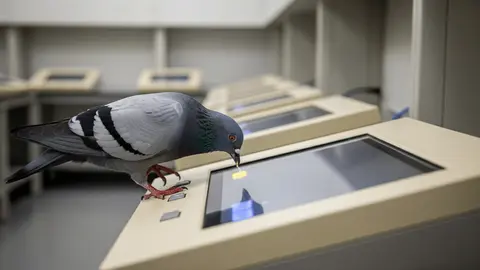
Pigeons cracked a problem built to defeat rule-followers, and it says something about AI
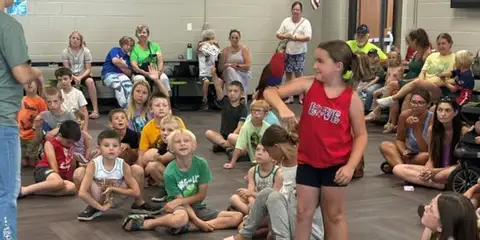
Florence County Library brings in an exotic animal rescue